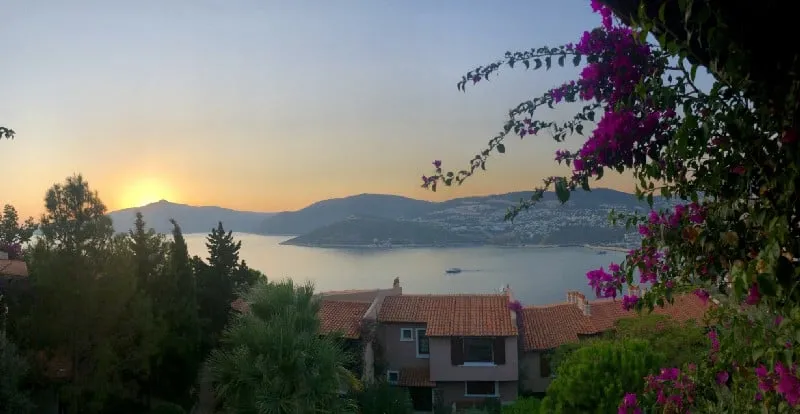
Kalkan is, in fact, a small town. The ancient civilisation of the Lycians has seeped into its barren soil, and a careful eye can still see what they left: sewer systems 3,000 years old, and the trace of lives devoted to wealth and to pleasure. Surrounded by ancient cities such as Patara and Xanthos, it is a hidden corner whose sea, water and air are fresh and sweet.
Kalkan has now become an English village, almost to the point where one could not enter without a passport. It has almost become Kalkanshire. As the price of enjoying the interest and the investment of the English, it is, for us Turks, more expensive than ever, and pointlessly so. We have my father's house here, one I have for years been unable to visit. At this time of year a holiday had not been possible. Of course I understood late that a real holiday on the Aegean coast is possible only around now. This year it was given to me to return to this house, to say goodbye to summer here, to rest, and to prepare for my new life.
There are more than a hundred restaurants in Kalkan's small centre. I do not know how to explain that there is no fresh fish on a shore where, at the sea's edge, you can see hundreds of fish with the naked eye, a shore clean enough to give Caretta caretta a place to nest. On Meis, the neighbouring shore, near enough that you could touch it if you reached out a hand, the coast is full of tavernas strung like a necklace, and of fish and meze at their very freshest, while the serving of frozen salmon in a sauce in Kalkan might almost count as a supernatural miracle. The waiters, too, with lordly English accents, serve the customers with an insincerity far from inviting. But let me not be unfair to Kalkan. Apart from the culture of eating and drinking, its shopkeepers are quite lovely people. With the effect of the climate, of a life without troubles, and of living with relatively less difficulty getting by (thanks to the English), they are people who speak in low voices, good-humoured and well-meaning.
In my new life I keep telling myself that I must value the money I earn. For that reason I acquired a small coin purse. I listened to a friend who said a person ought to value their own labour and know the account of their money. Because I had not fully taken this new approach into myself, though, in the pleasure of counting my coins I failed to notice that, getting out of the taxi, I had left my wallet, which held a substantial sum, all my credit cards and my identity cards, at the place where I had been trying to pay. And exactly 24 hours later, when I understood that I had lost the wallet, a sweet taxi driver brought every bit of it home to me, nothing missing.
This heroic driver, Ali Bey, had the day before told me at length on the road, and with pride, how his son, who studies in Istanbul, had entered Henkel by examination. Ali Bey, who did not know what a large firm Henkel is, told me proudly how pleased he was that his son's insurance was provided in full, and that lunch was covered by the company as well. He was glad his son had made a successful move from the small town into city life. He could not know, of course, that this successful young man would in fact spend his whole life working so that he might, in the end, build a life in a town like this, and that the life he was striving to leave behind would follow him like a mirage from which there is no return. I had shared his pride with affection, and I could not know either that the next day I would receive the reward for having seen him with the eye of the heart.
All through my adolescence, in our summer house in the woods at Şile, where we spent our summers, I complained of the loneliness and felt myself shut up in a tower like Rapunzel, and it never occurred to me that a day would come when I would go looking for peace in that house, in that wood. Adolescence, youth and the struggle to live always exalt moving away from one's family, standing on one's own feet, being happy in crowds. And after life has made its own crescendo, it flows once again, by many a turn, towards the quiet corner of the father's house, towards the feeling of it, towards simplicity and innocence, completing its own flawless circle. What is the fact that time is not linear, if not an emotional truth engraved in the very centre of the human heart, every bit as much as a scientific one?
If you ask what the main idea of the essay is, I suggest you watch the last scene of Cinema Paradiso, the most beautiful example of the search for innocence, and of the lament for a childhood that has been lost...